
Models
Add model providers and models, configure media understanding, and track usage and prices.
An agent calls a model: an upstream model of a model provider account, with the model API to call it through, its model input capabilities and optional pricing. Providers and models belong to one workspace, and agents select a model by its key.
Model providers
In Console, open Models → Add model → Connect a new provider, or manage providers under Workspace settings → Providers. Through the API, create a provider in /api/v1/model-providers as described in Providers.
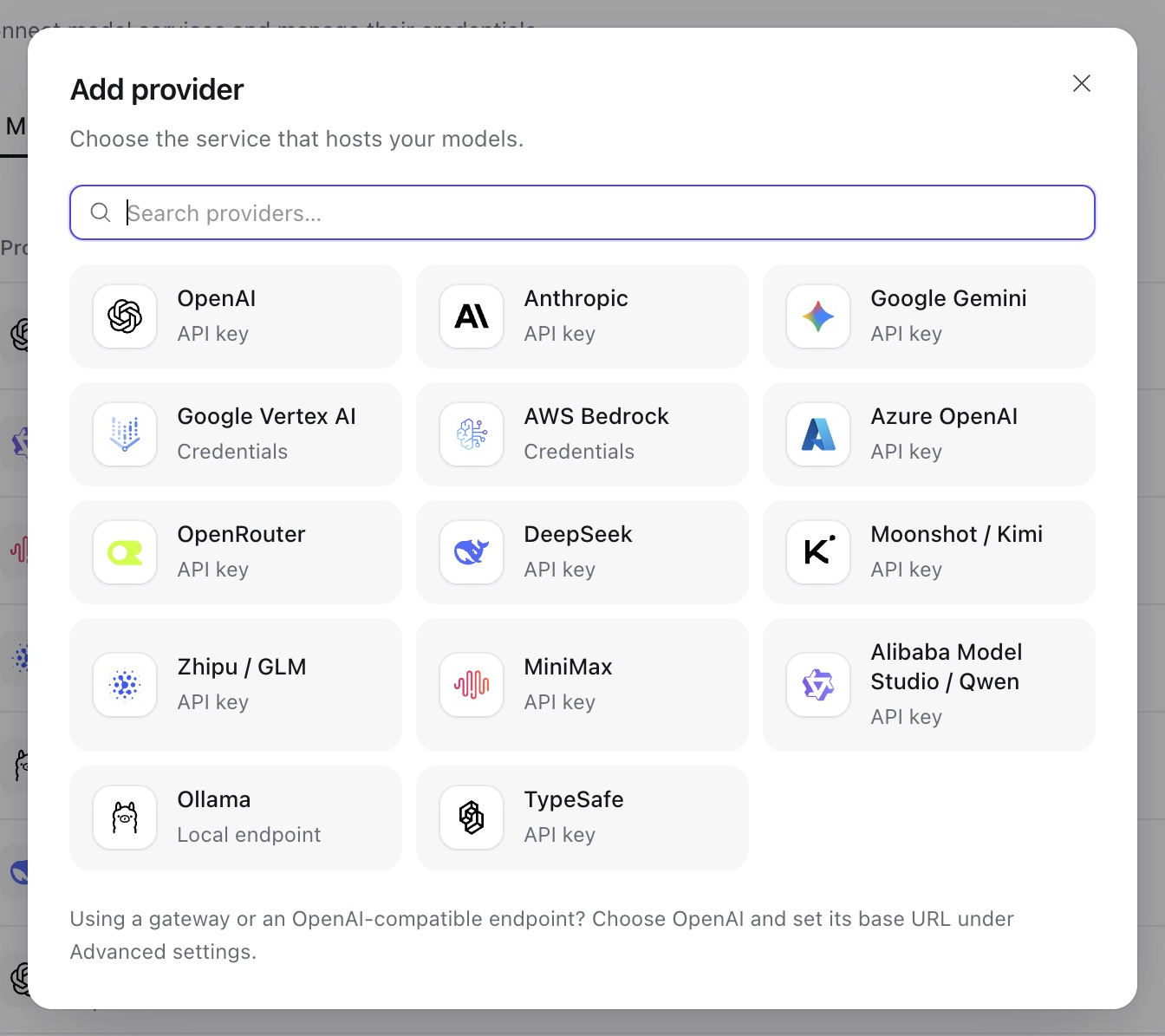
| Type | Model APIs (default first) |
|---|---|
openai | openai.responses, openai.chat_completions |
anthropic | anthropic.messages |
google_gemini, google_vertex | google.generate_content |
azure_openai | openai.responses, openai.chat_completions |
aws_bedrock | bedrock.converse, bedrock_mantle.responses, bedrock_mantle.chat_completions |
openrouter | openrouter.chat_completions |
fireworks, together, cerebras, sambanova, vercel, xai | openai.chat_completions |
ollama | ollama.chat_completions |
alibaba_model_studio, deepseek, moonshot, minimax, zhipu | openai.chat_completions |
typesafe | typesafe.system_one |
Each type's configuration and credential fields come from the Harness; GET /api/v1/provider-types/model returns them as JSON Schema. Most types take an optional base_url and an api_key credential. See Harness models and model authentication for each type's options.
Fireworks AI and Together AI support API-key credentials and optional base_url overrides. Fireworks defaults to https://api.fireworks.ai/inference/v1; Together defaults to https://api.together.xyz/v1. Use the full upstream model ID, for example accounts/fireworks/models/llama-v3p3-70b-instruct or meta-llama/Llama-3.3-70B-Instruct-Turbo. Their catalog channels are fireworks-ai and togetherai; availability depends on your account. Both offer a connection test without running inference.
A model provider may also carry up to 32 extra request headers, for gateways that route or bill by header. Header values are secrets: they are encrypted, never returned (views list only header_names), and edited per name in a PATCH ("X-Team": "..." sets a value, null removes it, omitted names are kept). Transport, authentication and protocol header names are refused.
Cerebras, SambaNova, Vercel AI Gateway, and xAI / Grok also accept API-key credentials and optional base_url overrides:
| Provider type | Default endpoint | Catalog channel |
|---|---|---|
cerebras | https://api.cerebras.ai/v1 | cerebras |
sambanova | https://api.sambanova.ai/v1 | sambanova |
vercel | https://ai-gateway.vercel.sh/v1 | vercel |
xai | https://api.x.ai/v1 | xai, x-ai |
For Vercel, use the gateway's full model ID, such as anthropic/claude-sonnet-4.6. Verify its credentials by testing a saved model: its public model list is not an authentication check. The other three offer a connection test without inference. The xAI / Grok provider uses HTTP Chat Completions. These provider choices do not expose Responses API or xAI's native server-side search tools.
ChatGPT subscription provider
Create an openai_chatgpt provider; the default flow registers an OAuth client dynamically and needs no static credential. In Workspace settings → Providers, choose ChatGPT subscription, add it, then use Sign in with ChatGPT. This authorization belongs to the provider and is shared by the workspace; it is not a personal connection.
With the default flow, after authorizing, copy the entire callback URL from the browser address bar into Complete callback URL, even if the loopback page shows a connection error. The Service can run remotely: it validates and exchanges the pasted callback without fetching that URL or requiring the browser to reach the server's loopback listener.
API clients use POST /api/v1/model-providers/{id}/authorize with {} and then POST …/authorization/callback with {"attempt_id": "oauth_...", "callback_url": "http://127.0.0.1:1456/auth/callback?..."}. Keep the full callback private. Invalid input is retryable; after the code exchange starts, a failed sign-in must be started again. GET …/authorization exposes credential-free status. DELETE …/authorization clears tokens before requesting revocation and reports when revocation is unconfirmed. The retained registration supports returning login; {"new_registration": true} starts a fresh account selection (a new dynamic client registration, or the same configured client without retained account hints).
Use openai.responses and an account model slug for this provider. GET …/models returns account-visible slugs and display names; manual IDs remain available in Console. A listed slug does not prove that the account may run inference with it. The endpoint is fixed, and tokens/pending authorization are encrypted in provider-owned state rather than model configuration or run snapshots. Every request sets store: false and streams its response; a non-streaming call collects the stream before it returns. Requests to this provider omit temperature, Top P and output-token limits; previous-response IDs and unsupported hosted tools fail explicitly. This does not translate the request into API-key behavior. Codex credentials are unrelated and cannot replace this authorization.
Self-hosted callback
The default dynamic-registration flow stays on HTTP 127.0.0.1, even after OpenAI issues a client ID; only the port can change. For an independently provisioned client, configure OAuth client ID, Callback URL, and Token endpoint authentication when creating or editing the ChatGPT provider. Public clients use none with no secret; confidential clients use client_secret_basic and require OAuth client secret. Save changes before restarting sign-in. The provider's config.client_id and config.redirect_uri override deployment defaults; blank fields inherit them. The secret is stored in the existing encrypted credential.client_secret, never in ordinary configuration or returned API data.
Deployment-wide public-client defaults can be configured before starting the Service:
export A13N_SERVER__PUBLIC_URL="https://agent.example.com"
export A13N_PROVIDERS__CHATGPT_CLIENT_ID="approved-public-client"
export A13N_PROVIDERS__CHATGPT_REDIRECT_URI="https://agent.example.com/api/v1/model-providers/oauth/callback"
These variables override [providers] chatgpt_client_id and chatgpt_redirect_uri in Service TOML. HTTPS callbacks must share the Service's configured public origin, so the initiating browser's cookie can return. Console reports automatic completion and refreshes status while the attempt is active; signing in must start from a user login session, not an API key. Manual callback paste remains available. To customize the public path, register that exact URI and set it on the provider or in A13N_PROVIDERS__CHATGPT_REDIRECT_URI. Then map that path in your reverse proxy to the Service's GET /api/v1/model-providers/oauth/callback, and keep the query and cookies. The callback never trusts Host/forwarded headers to choose its exchange URI. Exclude callback query strings from proxy/access logs.
Changing the client ID starts a new login without reusing another client's account binding; configuration or secret changes cancel pending/in-flight sign-ins; existing grants still refresh with their saved client authentication. Use another ChatGPT account keeps the configured client. Without a custom client, A13N_PROVIDERS__CHATGPT_REDIRECT_URI can override only the loopback port, not its scheme, host or /auth/callback path.
An OAuth client approved only for website sign-in has no permission to spend ChatGPT subscription quota. This integration still requires renewable tokens with the scopes that allow model calls on the ChatGPT plan; hosted/commercial use needs separate OpenAI approval. Confidential clients send their secret only in the server-side HTTP Basic header, retaining PKCE; code exchange, refresh, and revocation use the authentication frozen with that grant. Issuer, protocol endpoints, resource, and required scopes are fixed by this integration, not user-configurable OAuth parameters.
Add a model
In Console, open Models → Add model, choose the provider, then pick a model from the model catalog or enter its upstream model ID. The catalog lists recent text models from models.dev that the provider's type serves, one row per model, with a choice of IDs when the provider serves a model under several (such as Bedrock regions). A provider of the generic openai type also offers Other models (compatible), for an OpenAI-compatible endpoint serving another vendor's model. Picking a model fills in its upstream model ID, model input capabilities and prices, which you can change before saving. When models.dev has not been reachable since the Service started, Console says the catalog is unavailable; enter the upstream model ID instead.
Through the API, GET /api/v1/model-catalog returns the catalog's items and its status: ready, stale (the last catalog, while models.dev cannot be reached) or unavailable. Each item's ref, characteristics and pricing are values to copy into a new model:
curl "$A13N_URL/api/v1/model-catalog" -H "Authorization: Bearer $A13N_API_KEY"Create the model in /api/v1/models with its config:
{
  "provider_id": "mprov_...",
  "key": "local-llama",
  "name": "Llama (local)",
  "description": "Served by the team's Ollama host",
  "config": {
    "model_name": "llama3.3",
    "model_api": "ollama.chat_completions",
    "characteristics": {"capabilities": ["image_understanding"], "context_window_tokens": 131072},
    "settings": {"max_tokens": 4096}
  }
}provider_idnames a model provider of the workspace, whose credential the model spends.keyidentifies the model in its workspace: in paths such as/api/v1/models/local-llama, in agent configurations and in usage. It defaults to the provider's type and the upstream model name joined by-, lowercased, with any other character a key cannot hold replaced by-(ollama-llama3.3for anollamaprovider here); set it when that is already taken (409 already_exists). It never changes.config.model_nameis the upstream model name, andconfig.model_apimust be one of the provider type's model APIs.config.characteristicsdeclares the context window, context-management thresholds andcapabilities:image_understanding,video_understanding,audio_understanding, anddocument_understandingfor PDF documents.config.settingsholds native request defaults, such asthinking,max_tokensoropenai_reasoning_summary. An agent'smodel_settingscan override them.configalso acceptsmax_tokens,temperature,top_p,extra_bodyandextra_headersdirectly; when a key is also insettings, thesettingsentry replaces it whole, without a recursive merge.pricingprices the model's own calls in usage records; catalog items carry one to copy. The provider and model it names only record where the prices came from, so a catalog price copied for another endpoint's upstream model ID still applies.catalog_ref, such as{"provider": "openai", "model": "gpt-5.5"}, optionally records the catalog item'srefthe model started from. Console uses it for the model's icon and name; the Service never checks it against the catalog.enabled: falsecreates the model disabled.
A model spends its provider's credential, so creating a model or changing its config needs write on the provider as well. The provider and model belong to the same workspace.
Change a model with PATCH /api/v1/models/{key} (name, description, config, pricing, catalog_ref, enabled) and its If-Match, "{key}:{version}". Disable it with {"enabled": false}; models have no delete operation. Model-API-specific settings, such as reasoning effort, can be model defaults (config.settings) or agent revision settings (model_settings). Both are validated against the provider type's settings_schemas. These schemas leave out operator timeouts, upstream model selection and provider-account state (such as openai_previous_response_id, bedrock_inference_profile, openrouter_models or auxiliary openai_moderation models), and server-side tools such as openai_native_tools, which max_usage cannot fully account for.
Image input preparation
In a model's Advanced section, Image input defaults to Prepare images on, Support GIF on, Max images 20 and Max image size (MiB) 5. Binary GIFs are removed from model requests when Support GIF is off; image URLs are not fetched or classified. Max images zero removes all images; size zero disables the byte limit. The size budget measures base64-encoded bytes per image; 1 MiB is 1,048,576 bytes, not a decimal MB or the original file size.
The API field is config.characteristics.image_input, not config.settings. Omission enables default preparation, an object customizes it, and explicit null disables automatic preparation. All seven fields are available through the API; see the shared policy reference. Console preserves unexposed dimension and splitting fields and exact byte budgets when you edit other controls.
The primary model, a child run's model and an image-understanding model each apply their own policy. An attempt uses its resolved model configuration; later attempts, including recovery, resolve the current model just like other live model defaults. Unlike Harness UI, the Service does not freeze a model's configuration across attempts.
Advanced request settings
A model's Advanced section offers Thinking effort and Max output tokens, plus Reasoning summary and Store response for OpenAI Responses. These fields edit the same draft as Settings JSON, where other native parameters remain available. Leaving a field at its default does not force a reasoning effort or output budget; choose values supported by your upstream model. Model defaults apply to agents using that model, including reviewers and media understanding that use their own selected models.
For openai.responses, Store response defaults to off, even on existing models that never set openai_store. Set openai_store: true to opt in, or null to delegate to the provider. This controls upstream response storage, not the Service's own run history or the provider's other retention policies. Agent and run settings can override the default. Other calling APIs retain their existing storage behavior.
The API equivalent of a model's Settings JSON is config.settings. On an agent, use Provider-specific settings for model_settings. Both accept extra_headers; openai.responses and openai.chat_completions also accept extra_body for inference options the installed SDK does not yet know:
{
  "extra_body": {"reasoning": {"effort": "future-effort"}},
  "extra_headers": {"x-experiment": "candidate"}
}
This Responses example illustrates passthrough, not an upstream-supported effort value. Chat Completions uses its own wire fields, such as reasoning_effort. Ordinary typed settings remain preferable when available. Raw values win over ordinary inference settings at the SDK's final shallow merge; a raw nested object replaces its generated counterpart rather than merging into it. Model selection, messages, tools, structured output and provider session state cannot be changed this way. Use native openai_text_verbosity instead of raw Responses text, whose container also carries structured output.
Omit either object to inherit its model default; set it to {} to clear that default for the agent or run. A run's settings replace the agent's entire settings object, so model_settings: {} still inherits model defaults. To clear both defaults, send model_settings: {"extra_body": {}, "extra_headers": {}}. null is not accepted for these objects. Model and provider changes apply to later attempts, including resumed work; settings are checked again before requests.
Header values here are readable configuration. Put secrets in the provider's credential or encrypted extra headers instead. Request settings cannot replace authentication, protocol, existing provider header names or its session-affinity header, regardless of case.
Gateway session affinity
Set Session affinity in the provider's advanced connection settings to a header your gateway recognizes. The Service sends a stable thread-derived UUID on every model path, including reviewers and media understanding. Continuing a thread keeps the value; children and forks receive their own. It does not use the session ID or run ID, and clearing request header defaults does not disable it. The gateway must implement routing for that header; selecting a preset does not configure the gateway.
Model API availability
A model's config.model_api must be one the deployment offers; checking its settings, such as when an agent revision is saved, answers 503 unavailable with {"dependency": "model_api:<api>"} for one it no longer offers.
Media understanding
An agent whose model cannot read images, video or audio can delegate that to another model. Each workspace can set a default per media kind, and each agent can choose its own.
In Console use Workspace settings → Media understanding. Through the API, workspace administrators replace all three defaults at once, by model key, with the ETag that GET /api/v1/media-understanding-defaults returns:
curl -X PUT "$A13N_URL/api/v1/media-understanding-defaults" \
  -H "Authorization: Bearer $A13N_API_KEY" -H "Content-Type: application/json" -H "If-Match: $MEDIA_ETAG" \
  -d '{"image": "gpt-5.5", "audio": null}'
An omitted or null kind has no default. Each model must be usable in the workspace and declare the matching model input capability (image_understanding, video_understanding or audio_understanding).
At execution, an agent's own media_understanding choice wins and must be usable, or the run fails. A workspace default that is no longer usable is skipped with a warning, and that media kind is unavailable to the run.
Usage and prices
Every model call of a run is recorded as a usage record attributed to the model that made it, and priced by that model's pricing, with a snapshot of the pricing at that time. This holds when two models used by one agent and its subagents name the same upstream model, even through providers of the same type, and when the provider answers under another model name, such as a dated snapshot of an alias. See usage.